Other distance metrics
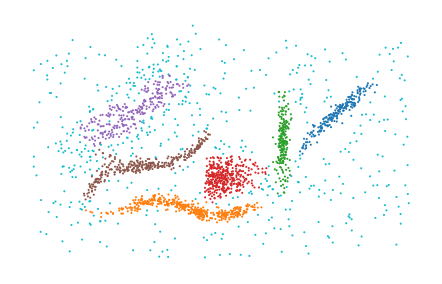
The basic usage page demonstrated PLSCAN’s most common input type: feature-vector with Euclidean distance. The packages supports several other distance metrics and inputs.
[2]:
import numpy as np
import matplotlib.pyplot as plt
from fast_plscan import PLSCAN

plt.rcParams["figure.dpi"] = 150
plt.rcParams["figure.figsize"] = (2.75, 0.618 * 2.75)

data = np.load("data/clusterable/sources/clusterable_data.npy")
mst = np.load("data/clusterable/generated/clusterable_mst.npy")
Non Euclidean distances
We use scikit-learn’s kd-tree and ball-tree to efficiently find neighbors and compute the minimum spanning tree. All distance metrics supported by these space trees are also supported by PLSCAN.
[3]:
print(PLSCAN.VALID_BALLTREE_METRICS)
['euclidean', 'l2', 'manhattan', 'cityblock', 'l1', 'chebyshev', 'infinity', 'minkowski', 'p', 'seuclidean', 'braycurtis', 'canberra', 'haversine', 'mahalanobis', 'hamming', 'dice', 'jaccard', 'russellrao', 'rogerstanimoto', 'sokalsneath']
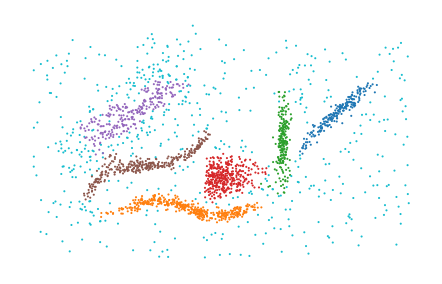
For example, using the minkowski distance with power factor 3.3:
[4]:
labels = PLSCAN(
    space_tree="ball_tree", metric="minkowski", metric_kws=dict(p=3.3)
).fit_predict(data)

plt.scatter(*data.T, c=labels % 10, s=1, linewidth=0, cmap="tab10")
plt.axis("off")
plt.subplots_adjust(left=0, right=1, top=1, bottom=0)
plt.show()
Precomputed distances
PLSCAN supports pre-computed distance in several formats:
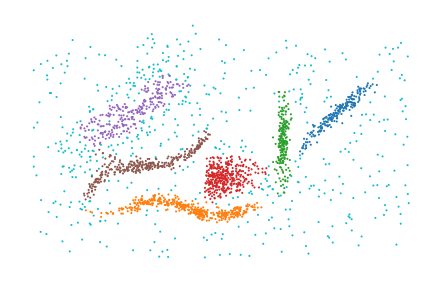
(sparse) distance matrices:
[5]:
from sklearn.metrics import pairwise_distances

dists = pairwise_distances(data)
labels = PLSCAN(metric="precomputed").fit_predict(dists)

plt.scatter(*data.T, c=labels % 10, s=1, linewidth=0, cmap="tab10")
plt.axis("off")
plt.subplots_adjust(left=0, right=1, top=1, bottom=0)
plt.show()
condensed distance matrices:
[6]:
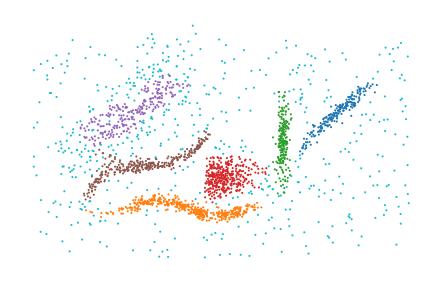
from scipy.spatial.distance import pdist

dists = pdist(data)
labels = PLSCAN(metric="precomputed").fit_predict(dists)

plt.scatter(*data.T, c=labels % 10, s=1, linewidth=0, cmap="tab10")
plt.axis("off")
plt.subplots_adjust(left=0, right=1, top=1, bottom=0)
plt.show()
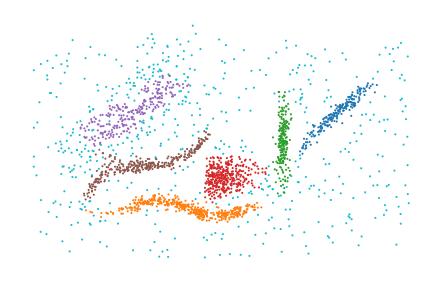
precomputed minimum spanning trees:
[7]:
# min_samples=5 matches the precomputed MST.
labels = PLSCAN(min_samples=5, metric="precomputed").fit_predict((mst, data.shape[0]))

plt.scatter(*data.T, c=labels % 10, s=1, linewidth=0, cmap="tab10")
plt.axis("off")
plt.subplots_adjust(left=0, right=1, top=1, bottom=0)
plt.show()
k-nearest neighbors lists
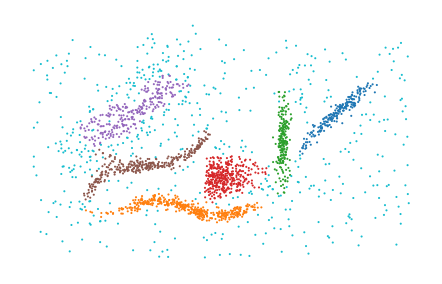
[8]:
from sklearn.neighbors import NearestNeighbors

knn = NearestNeighbors(n_neighbors=10).fit(data).kneighbors(data)
labels = PLSCAN(metric="precomputed").fit_predict(knn)

plt.scatter(*data.T, c=labels % 10, s=1, linewidth=0, cmap="tab10")
plt.axis("off")
plt.subplots_adjust(left=0, right=1, top=1, bottom=0)
plt.show()
sparse distance matrices:
[9]:
g_knn = (
    NearestNeighbors(n_neighbors=10).fit(data).kneighbors_graph(data, mode="distance")
)
labels = PLSCAN(metric="precomputed").fit_predict(g_knn)

plt.scatter(*data.T, c=labels % 10, s=1, linewidth=0, cmap="tab10")
plt.axis("off")
plt.subplots_adjust(left=0, right=1, top=1, bottom=0)
plt.show()