Clustering with multiple components
Computing minimum spanning trees on large, high-dimensional data can be a lot more expensive than finding (approximate) nearest neighbors. In cases where sufficient neighbors are detected, this compute cost can be avoided by clustering on the (approximate) knn graph because PLSCAN supports inputs that form multiple connected components.
[1]:
import matplotlib.pyplot as plt
from fast_plscan import PLSCAN
from sklearn.datasets import make_blobs

plt.rcParams["figure.dpi"] = 150
plt.rcParams["figure.figsize"] = (2.75, 0.618 * 2.75)

X, _ = make_blobs(n_samples=200, random_state=10)
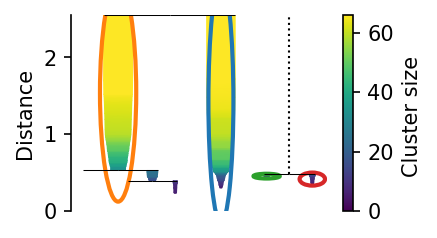
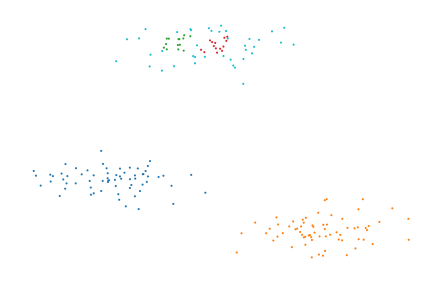
The 50 nearest neighbors of this data set do not form a single connected component. PLSCAN will compute clusters as if each component in the input was given separately. As a result, the components themselves cannot be detected as clusters.
[2]:
from sklearn.neighbors import NearestNeighbors

knn = NearestNeighbors(n_neighbors=50).fit(X).kneighbors(X)
c = PLSCAN(metric="precomputed").fit(knn)

plt.scatter(*X.T, c=c.labels_ % 10, s=1, linewidth=0, cmap="tab10")
plt.axis("off")
plt.subplots_adjust(left=0, right=1, top=1, bottom=0)
plt.show()
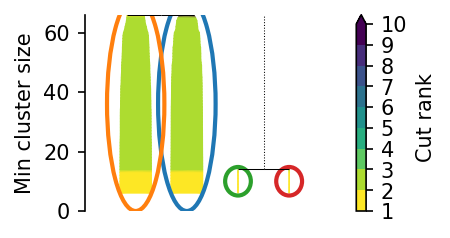
The leaf and condensed trees are not compatible with code written for hdbscan because they may form forests instead of trees.
[3]:
c.leaf_tree_.plot(select_clusters=True)
plt.show()
[4]:
c.condensed_tree_.plot(select_clusters=True)
plt.show()